Server + client system / Multi-surface
RemotePad
A remote control system made of a Windows server, a mobile client and a shared message model that defines the protocol between them.
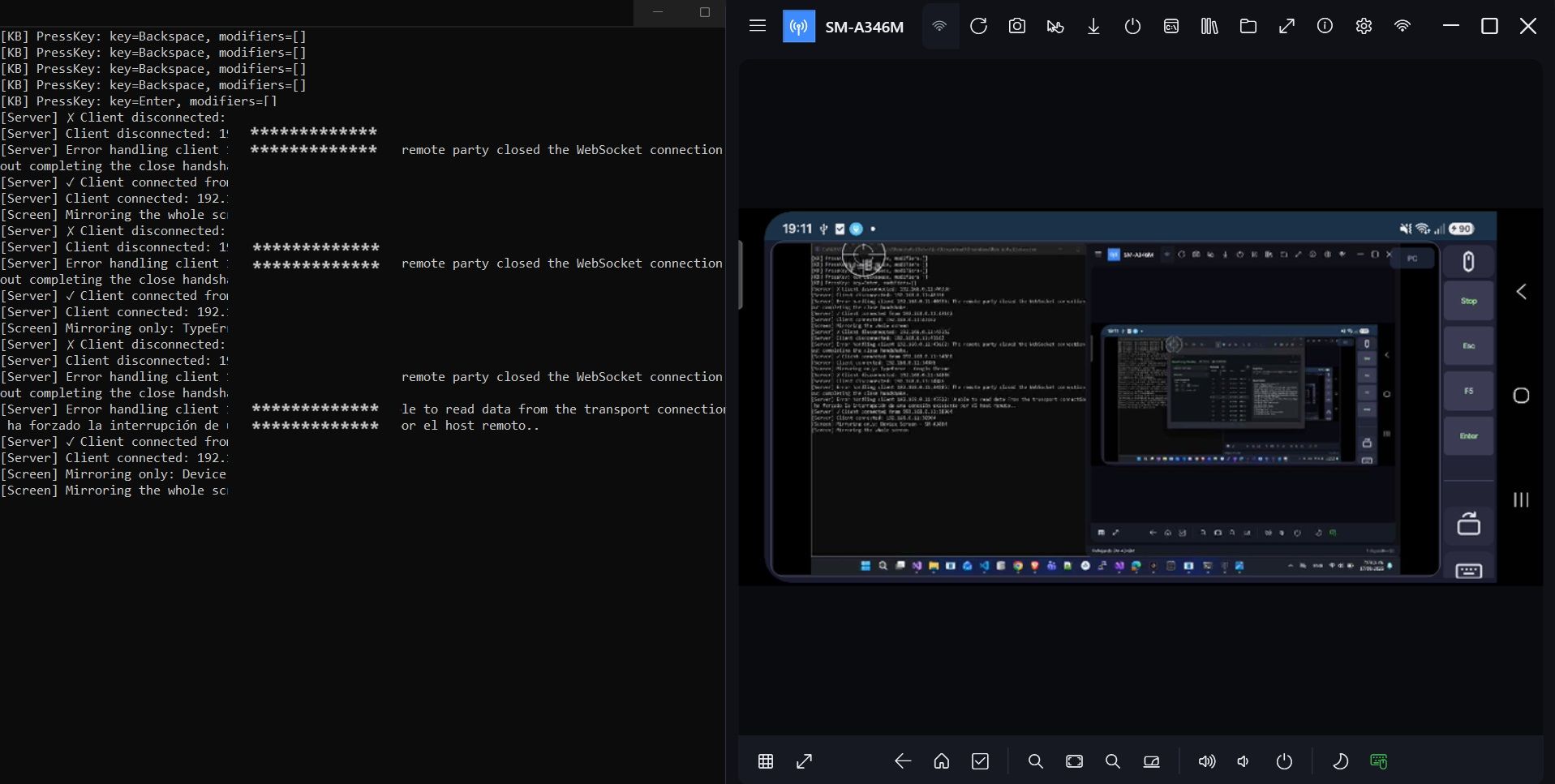
The problem
Controlling a machine from a phone looks like an interface problem, but it is not: it is a protocol problem. Before the touch surface can feel natural, you have to decide which messages exist, who originates them, what happens when they are lost, and how two devices that never met pair up.
Constraints
- The server needs elevated permissions to act on the operating system
- Perceived latency of the touch gesture is the quality bar
- Local-network pairing with no manual configuration
Decisions
Outcome
- Shared message model defining the protocol
- Mobile client with touch controls on an MVVM pattern
- Windows server with keyboard, pointer and screen capture integrations
- Local-network pairing flow
It is a system, not an app
The visible part is an app on a phone. The part that matters is spread across three pieces: the server acting on Windows, the client capturing the gesture, and the message model defining what each can say to the other.
That third project — the contracts — is what lets the other two evolve separately. A new message is added in one place and both ends stop compiling until they handle it. That is exactly the behaviour you want from a protocol.
Why it belongs here
Because the same pattern — two distinct surfaces communicating through an explicit contract — is what holds up the large systems I work on. Here it is in its smallest complete form, which is why it reads at a glance.